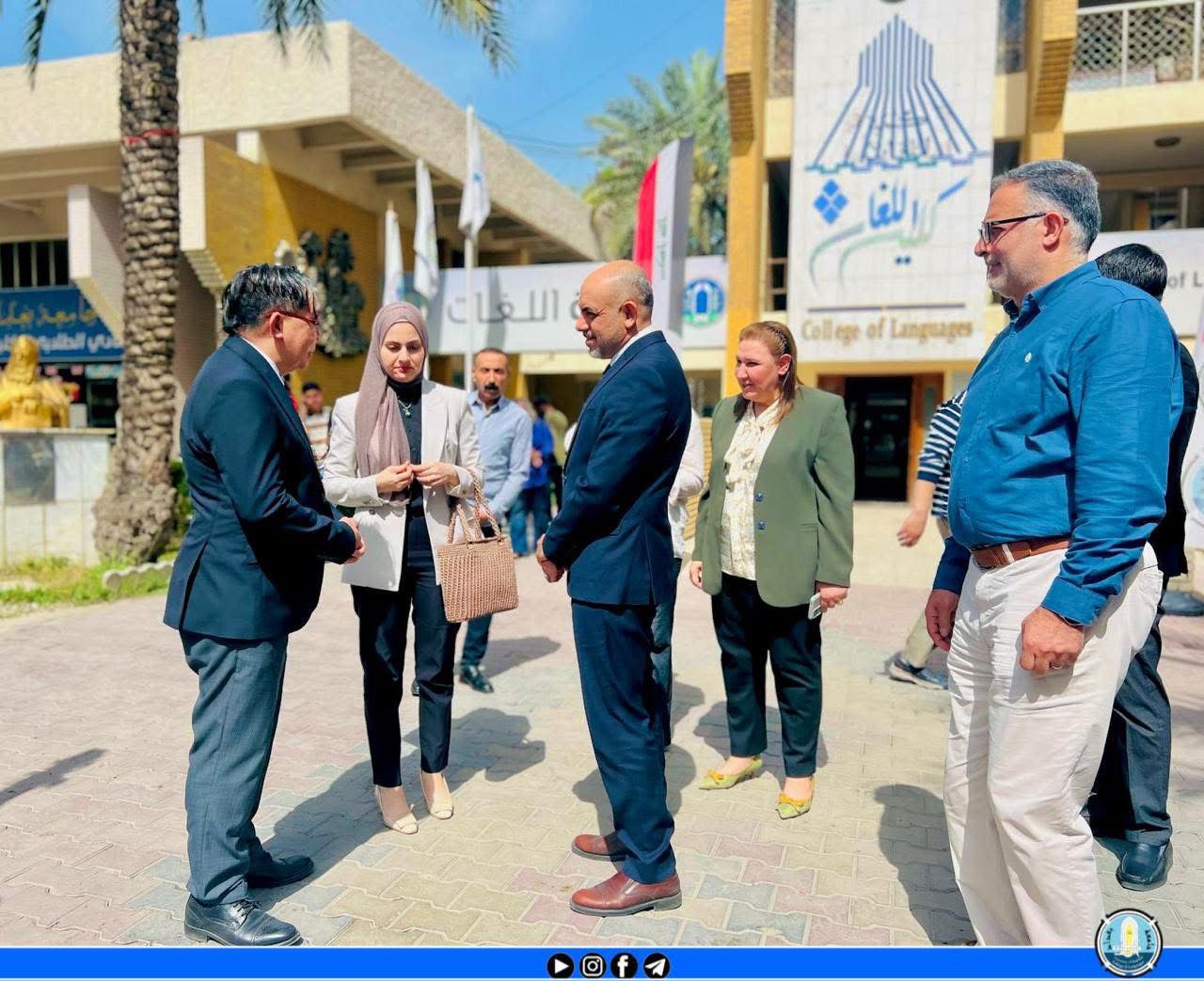
The Department of Spanish is one of the most prestigious departments in the College of Languages and the only one nationally. several generations of teachers, interpreters, employees, and workers in the Ministry of Foreign Affairs and Iraqi embassies in Spain and Latin America, as well as many of their affiliates, have graduated from this department. The Ministry of Culture and Public Relations collaborated with the other ministries and institutions that are responsible for dealing with Spanish-speaking countries. Some of these ministries and institutions carried the banner of teaching the Spanish language in secondary schools in Baghdad as a pioneering experience. This experience has begun to show its outcomes, and there is hope for its improvement in the near future. The Department of Spanish was established in 1953 at the Higher Institute of Languages in Baghdad and became one of the departments of the College of Arts / University of Baghdad in 1958. In 1987, it was separated from the College of Arts to be one of the effective departments in the College of Languages. The Department has a library that includes a valuable collection of books on Spanish linguistics, literature, history and civilization.
Leadership in Spanish language education and excellence in scientific research.
The Department of Spanish Language at the College of Languages, University of Baghdad, is a specialized academic institution dedicated to the teaching of the Spanish language and its literature. The department is distinguished by its specialized faculty and modern curricula that keep pace with academic developments. It seeks to prepare qualified academic cadres possessing outstanding linguistic and research skills, capable of contributing to the labor market through translation, intercultural communication, and the promotion of cultural and scientific understanding among peoples. These objectives are achieved through the development of educational programs, the encouragement of scientific research, and the adoption of modern teaching methods and advanced educational technologies.
Develop students’ linguistic skills.
Prepare graduates for the labor market.
Integrate technology into the learning process.
Build students’ character and enrich their cultural knowledge.